
Cedar Shake House
by Jesse Jing
When I was a baby I loved more than anything to be left alone. I know this from Thanksgivings and Christmases, when aunts and uncles would laugh about how strange an infant I was and my father would smile his strained smile. I think it pained him to remember how I would scream and scream until, desperate, he would walk out to find a new teething toy or bottle or pair of tiny socks, and notice that I quieted as soon as the door shut behind him. I imagine that stings for a parent. To have your baby inconsolable not in your absence but in your presence. I can see how that would hurt a decade down the line, over canned green bean casserole and elk lasagna and sparkling cider. I always felt vaguely bad for him at these gatherings, surrounded by his sisters and their husbands who all showed up in minivans with the white backsides of stickers barnacled over the rear windows, their children riotous and tumbling over one another in the yard but afraid, or just unwilling, maybe, to touch me.
We lived in a stand of cedar trees. They dropped their flat feathered needles on our cedar roof. The walls and floor and paneling of our house were all cedar, as if the house had sprouted from the duff and was letting us live inside it like squirrels while it took its sweet time rotting back into the forest floor. This house had always held me and my father and absolutely no one else.
My father made a living fixing small appliances and electrical equipment of all kinds. It seemed dangerous to me to have the green guts of circuitry and motherboards lain open underneath our damp roof. The smells of hot solder and wet cedar. He worked into the evenings, so that sometimes as I fell asleep I would hear the crack of a plastic casing being pried open and the ringing of loose screws dropped into a clean ashtray. I imagined him picking out the choicest bits to eat. I pictured him crunching on diodes and transistors and belching out sparks. I could so clearly see the way he’d pat a small, igniting flame out of his mustache. I knew my father the way I knew sunlight was warm and water ran downhill; I knew my father the way I knew the chip in my favorite mug, and the way I knew the knots in the wood of my ceiling, and the way I knew the wiggle-trick to the bathroom doorknob.
For comparison, these were the things I knew about my mother.
One, she had long grey hair, and kept it in a braid over one shoulder. I knew this not because I had a picture of her to look at but because it was the only detail my father would tell me.
Two, there was a wooden box on the mantel with her name on it. He had explained to me that the gritty grey dust inside was her, was her body. I found this ridiculous. I was disappointed that he would believe it, but I had begun to understand that adults were easily influenced by false things and, once convinced of a new nonsense, would not let it go.
The rest of my questions were deflected or outright ignored. And so this was all I knew of my mother.
When I was old enough to ride the school bus I went looking for her. I had gotten it into my head that she had left on a boat. This is probably because in all of the children’s books I read people traveled by boat, always stowing away on ships and ending up on islands, hot blue tropical isles or the drab grey of Britain or some desolate Grecian cave-rock. I became convinced that my mother had boarded a ship out of some necessity and as a consequence of her journey I would need to have my own, like I was a sequel. If I followed the rules set by narrative wisdom, if I picked the right locks and made the right mistakes, I would find her. That was how stories worked.
The morning I left, as in every morning, my father set breakfast in front of me. It was a hot, dark slice of rye thickly spread with butter and marionberry jam and a pair of eggs the way I liked them. He placed a paper bag containing my lunch beside it, patted me on the head, picked up his fishing gear and went out the back. I did not feel bad for concealing my plans from him. I made six extra sandwiches and locked the door behind me when I left.
When the school bus arrived at our house I sat at the rear. When the school bus arrived at the school I crawled beneath the seat with my pack. When the driver walked the length of the aisle to check for children he did not look under the seats, and so I spent the drive to the bus depot crouched among gum wrappers and pencil stubs. Tires crunched on gravel, and then stopped, followed by the jangle of keys, then the sound of the driver exiting. I counted to one hundred. Then I walked up the empty aisle and stepped out. Mist dripped over the depot as I slipped between kneeling yellow buses and ducked under the padlock at the front gate.
I was on a road along which someone had cut most of the trees. A closed gas station was across the street. I knew the coast was to my left and I began to walk. In one hour I could smell the sea and in two I could see it as a bitter seam of light let in at the horizon.
I crossed the empty highway and found a rutted path down to the shore. The beach was small and rocky, cut in half by a rivulet of dilute rustwater that ran down from the road. As I walked I crunched bruise-blue mussel shells and coffee cup lids. Nobody was there. Near the water lay heaps of shining kelp as high as my waist. I sat on one, for lack of a better place to sit, and sunk half into it like a beanbag. I pulled out the first of my sandwiches, and looked at the waves, and began to wonder for the first time how I would locate my mother in or beyond the Pacific Ocean.
As I ate, I scanned the sharp grey edge of the sea for boats. I was focused so intently on the distance that it took a long time to notice a car-sized lump in the waves by the shore, like a shoe beneath blankets. The lump rocked steadily back and forth. With patient and tremendous effort, the wavelets inched it closer and closer to land, until with a final rolling heave the massive lump was laid on the rocks beside me. It had a smooth, perfect oil-black hull, and an equally perfect creamy white underside, with a huge white false eye that stared dreamlessly up. The orca’s mouth gaped like a wound, wide, too pink, studded with teeth. A tremendous burbling gush of putrid air heaved out of it and washed hotly over me. I put the rest of my sandwich back in the paper bag.
Hello, I said. I’m looking for my mother.
Beneath the enormous pearl of the false eye was a tiny dulled black eye. Why would she be here? it asked in a rank, wet voice. Did she love the sea?
I don’t know, I said. She had a long grey braid over one shoulder. Have you seen her?
She must have loved the sea, groaned the dead orca. Look at it. What else is there to love?
Lots of things, I said. Forests. Deserts. My father. Have you seen her?
No, it moaned. Is she dead?
No, I said. No she is not dead. No.
It is not so bad, being dead. A pair of seagulls had alighted on its enormous side and were beginning to peck.
This response made me very angry. We were both silent, looking out at the grey, and I made no move to shoo off the gulls as they started to excavate yellow hunks of fat from its flank.
You could try the rivers, it rumbled, eventually. Things come down from them. All sorts of things.
What sorts of things, I asked.
Things that taste good. Things that do not. It deflated slightly with another reeking gust. More seagulls were wheeling noisily down from the sky. Follow this one. Follow it up. You will find her.
Thank you, I said, and put on my pack. Goodbye.
It laid there and did not say goodbye.
I followed the greasy trickle back to the road and ducked into the metal culvert it flowed through. My shoes sank in and broke the oily rainbow patterns on the silt. It did not seem like a river to me. It seemed like a ditch that ran along a road. I followed it anyways, up, and up, back the way I had come, until it joined with a sweeter, clearer, wider stream, and this too I followed dutifully up. As I stepped carefully upstream on the rocks and branches the water flowed down between my feet, creating the sensation of walking up a down escalator, and after many hours of this it still seemed as if I were in exactly the same place along the water, slipping on the same wet rocks and catching myself on the same slimy branches.
I was soaked to the knee and moving slowly by the time I came to a tall metal culvert. It was made from a corrugated pipe wider in diameter than I was tall and clogged entirely with debris and waterlogged branches. Stream water spurted fitfully out through the limbs. Atop it ran a road. I climbed up to the road and took a second to enjoy the flatness of asphalt beneath my sneakers.
Hey, said a rough tin can of a voice.
I looked around—trees, moss, stream, road, trees, moss. There was no one.
I said hey!
I looked down at my feet. A misshapen lump of black laid there, loose feathers riffling in the breeze. Its beak looked like a coal in a cold firepit.
Nincompoop, said the crow, blinking a small white worm out of its eye.
I thought crows were too smart to get hit by cars, I said.
Oh! Oh how rude! I thought human children were too smart to be so rude! (Here the crow also called me a name which I do not think I’m allowed to write down.)
I’m sorry. I’m looking for my mother. She has a long grey braid. Have you seen her?
The crow cackled. Everyone wants to know what I’ve seen. Why should I tell you?
Please, I said. I walked here from the sea.
The sea! I’ve seen the sea! You wanna know about the sea? It’s terrible. Don’t bother with the sea, kid, just way too much water out there. Ridiculous.
But have you seen my mother?
Who knows? It laughed a creaky cackly laugh. Probably! What’s in it for me, skin scarecrow?
I don’t know, I said. I could move you somewhere. I could move you out of the road, maybe.
Bah, it said. I like it here. I like reading the bumper stickers. Listen, you meaty fledgling. Here’s what you can do for me. You can go to the mountain. I never got to go to the mountain.
What mountain? I asked.
The crow’s cracked beak shrieked with laughter. Ha! What mountain, it says. What mountain! There’s only one mountain. Look, there. See?
I looked sideways down the tree-lined road. Visible at the end was a pale shape so vast it looked like a settled stone glacier of cloud, a texture wrinkled into the mute fabric of the sky, a shape that could absolutely not be a real, solid thing of this earth.
Oh, I said. I see the mountain.
Oh, good work, leg beast, gold prize! Blue ribbon! I don’t know how you creatures do a single thing. Absolutely useless. Clowns, all of you. Anyway, go there.
Um, I said. Thank you for your help.
You’re very welcome. You’re gonna find her.
I am? I asked. Wait, I mean, yes. I know. I am. But the crow was cold and still as litter. I sat down next to it, ate another sandwich, drank from my water, and soon enough stood and began to walk down the road.
I moved much more quickly on the asphalt than I had slogging along the stream. The mountain remained an incomprehensible, impossible distance away, and every time I looked up along the road it seemed more like a painted backdrop; and yet it was so vast and still that continuing towards it was the only thing that made any sense, its gravity turning my uphill trek into an effortless fall. No cars passed me. The smooth straight road beneath me became a tarry cracked one, and then a gravel bed, and finally a pair of dirt tracks that wound among the pine trees so that I lost sight of the white peak. Here the branches pushed close and the dirt road turned into pale crunchy stone that tripped me up or crumbled underfoot. I had to select each step so as not to roll an ankle, and so I was so focused on my own feet that I hardly noticed when I ran out of road.
Unexpected sunlight touched on my face and I saw that I had come to the end. It was a wide turnaround at the edge of a gently sloping cliff. The trees cleared and there was the mountain once again, thrice as large as the last time I’d seen it, half of the sky and the whole of my vision; I took its face in properly now. It had a raw white broken-open peak and stark black ribs. It had a ribbon of ash that curved around its slope, a motionless winding river of grey. Around it endless puddled skirts of white became grey became green where terraces on terraces of spilt cinders had come to rest and the mosses were just beginning to cling. It was a cataclysm come to rest.
Oh, I said. Oh.
I stepped unthinkingly towards it and fell straight down, juddering in a whirl of rocks and painful impact. Gravity smacked against me, hard. I was still. I breathed a few careful dusty breaths. When it did not hurt to breathe I sat up. I tested the flex of my limbs and turns of my joints and found that they were sore but unbroken, and that I sat in a gritty ravine filled with ashy grey pumice.
You, creaked a voice very close, startling me badly.
The source of the voice lay within arm’s reach of where I had landed: a jumble of bones among the rocks, their knobs and curves huge, smooth, the color of old butter. The ribs were longer than my legs. The skull had wide flat teeth and enormous antlers that arced into pointed tips above my head.
You, it said again.
I did not know what to say.
You have found her. A few dry tendons still held the jaw to the skull, and I saw that these flexed weakly when the elk spoke.
What? I said. I was badly shaken.
You have found her. Its voice was a weak, parched creak.
My mother? I asked. You mean my mother?
You have found her. Its wide clean eyesocket took in the whole disc of sky.
Please, I said. No I have not. Do you know where she is? Can you tell me?
You have found her.
I haven’t, I said. I haven’t! I’m looking! I’m still looking!
You have found her.
I stared at the elk and its gaping blank eye hole.
You have found her.
Stop, I said. Stop it.
You have found her.
Please.
The skull fell silent. I stared at it and was filled with a hot helpless anger that churned my gut. I was bruised, hungry, and wet with river water from the knee down. I had so many questions and one useless answer. I glared at the white skull, willing it to say something else. Rich honeyed light from the sun caught on the long points of its antlers. I turned and saw that it was getting late: the sun hung heavy, and the vast volcanic spill around the mountain had sunk into shadow. I watched the rosy orange light creeping up its massive snowy shoulders, its crater filling with dusk, its long braided ash-river darkening to pewter.
As I looked at the grey river I felt, for a long moment, a sensation I cannot quite put to paper, a sort of seismic drop inside of me. A long grey braid over one shoulder. I thought of the box on the mantel at home, full of fine grey grit. I dug my hand into the powdered pumice-sand beneath me and saw the gritty grey ash in my palm.
You have found her, creaked the elk. This time I felt no anger at all. I laid my palm on its rib, imagining the warm hairy flank it had in life.
Yes, I said. I have. Thank you for your help.
It was beginning to get cold. I sat in the ravine and looked at her rising in the far, far distance, and you will say I cannot know this for sure, but she sat there and she looked at me.
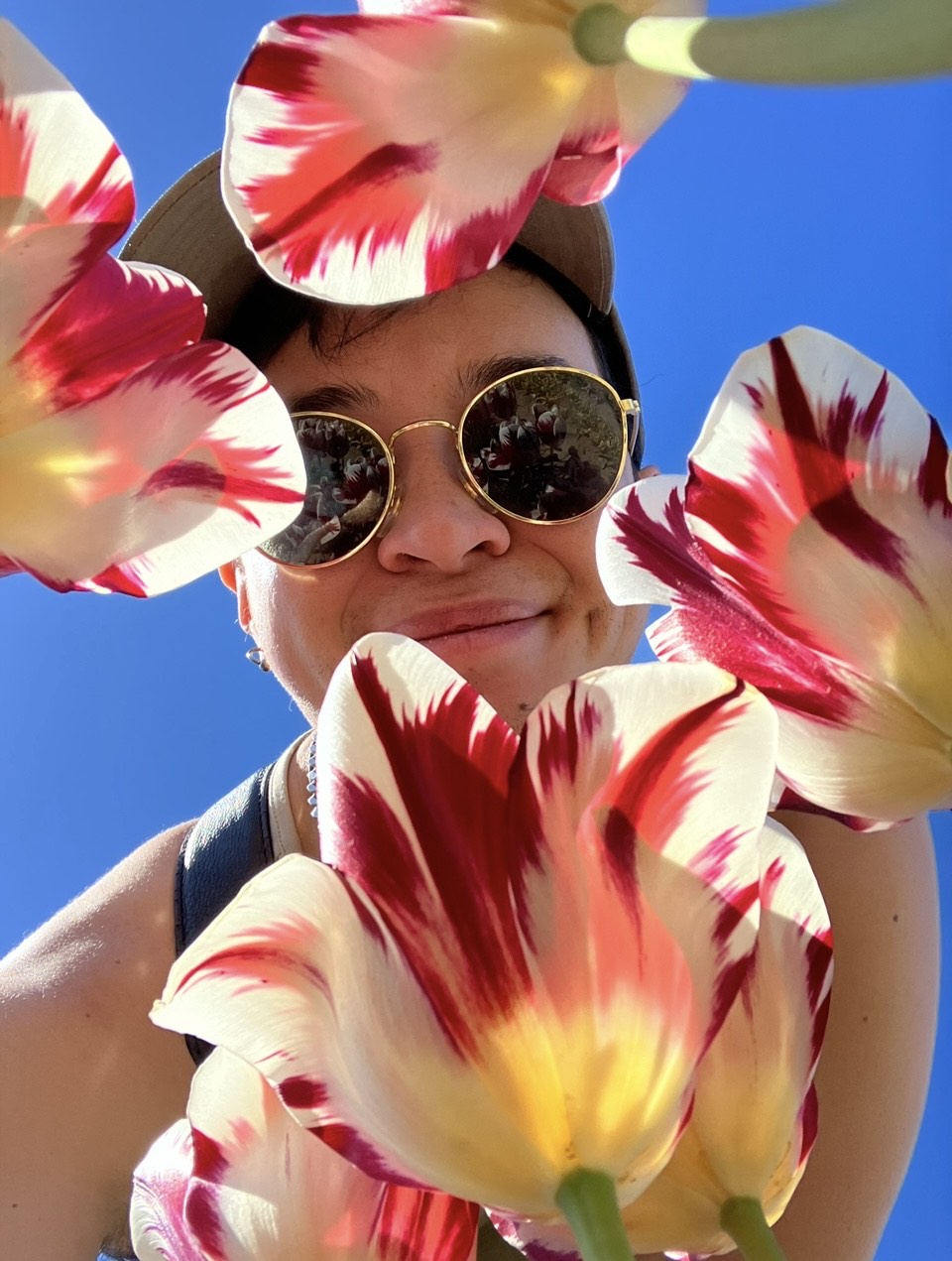
Jesse Jing
Jesse Jing lives in western Oregon, where they spend their time doing pollinator biology, fire ecology, and trying their hand at all types of art. This is their first published piece of fiction. Find them at macrotera.neocities.org.