
In the Water
by J.P. Kemmick
A report on lake monsters in the fourth grade. The memory of Blake Willis, a boy we’d known all our lives, who walked into the lake early that spring with his dad’s dumbbell tied around an ankle. The creeping, steady suspicion that something was being withheld in the murky depths.
Whatever it was, I kept a watchful eye on the lake that mercury hot summer, Kayla, Lucy and Benitha my constant companions. An ugly, muddy lake, but we worked with what we had. The city put in a floating dock and we were all day, every day out at that dock. All summer to turn our backs to the land. All summer to test how well we could pass our timid selves off as brave. To play with transformation.
#
July, two weeks since school let out. Kayla laying to my right, Lucy to my left, the sun overhead turning us dark. Benitha somewhere in the water, imploring us to join her, warning us about cancer, about the eyes of boys, about a TV special she once overheard standing outside her mother’s bedroom about a serial killer who preyed on young girls he met at beaches.
“He cut them up. Little pieces, you guys.”
We were thirteen, fourteen. Damn near full time living on that floating dock. Marooned, by choice. Back on the beach Kayla’s mom was exploring her freedom after the divorce, Lucy’s parents were whispering about a possible move to Texas and my parents were trying to keep my brother out of juvie. It was a lot, on land.
“With a knife or, like, a saw?” Lucy asked.
“I don’t know,” Benitha said. “Does it matter?” Benitha’s mom was from Rwanda, a refugee, a word Benitha had a love/hate relationship with, in that she was proud of her mother for overcoming hardships and in that she didn’t really understand what a refugee was, although she was happy to explain it to us, changing the definition every time. We didn’t hold it against her. Nothing was constant that summer, except our hunger for change, and for boys.
The boys were fourteen, fifteen, another year, or even months, and they’d be too old for the floating dock, too old to talk to us girls, too old to fling their bodies off the diving board, twisting and flipping to impress us lying there in the sun, squealing when they splashed us. We knew their names, but not always who each name belonged to. Kevin, Ahmed, Luke, Neil, Taylor, Tray, Nick. More, but those were the boys who showed up most often, who swam with broad, confident strokes from the beach out to us, marooned and thankful.
#
The way some girls at school walked, you’d think they owned the world. But you can’t own the world. Even then we knew that. All you could really hope for was a sliver of it. Or a little square, floating on a lake. Lucy was our enforcer, helping us lay claim to the dock. A thankless job, but she had the best scowl among us, picked up from her mother, an expert in the art of unhappiness.
One morning, Lucy got to practice her scowl on a new boy. The clouds hadn’t yet burned off, but we four girls were already convened, the dock, momentarily, all ours. The new boy—not a Kevin, Ahmed, Luke, Neil, Taylor, Tray or Nick—appeared suddenly, clinging to the side of the dock. We loved watching the boys swim out, loved watching their brawny shoulders, but this one, he came out of nowhere.
“Jesus Christ,” Lucy said, propping herself up on a shoulder. Scowling.
“I scare you?” the boy said. Wide grin.
“I wasn’t scared,” Lucy said, composing herself.
“I was,” Benitha said.
A moment passed as the boy bobbed with the dock, water dripping from his head down his long nose and over his lips.
“Lyle,” Kayla whispered, trying to guess his name. It was a game we sometimes played.
“Kyle,” Benitha said.
“Lyle is an old man name,” I said.
“Sal,” the new boy said. “My name is Sal.” No water in Sal’s ears.
“Sal,” Lucy said, “do us the favor of announcing your presence in advance next time.”
“Deal,” Sal said, and he hoisted himself up. Long torso, smiley faces on his shorts. A little adorable tangle of hair in the indent of his chest. But that first morning he wasted no time with us. Walked right over to the diving board and leapt into a tucked flip, his long body folding in on itself like fleshy origami. The world did one of those neat tricks where it turned sharply on its axis with a sort of sudden stutter start that throws you completely off balance.
Sal left hardly a ripple on the water’s surface. Barely a trace. For a long while, it seemed like the water might just be his home.
By the time his head breached the lake’s surface, he was half way back to land.
#
Soon enough, the rest of the boys arrived, as they always did, and we girls huddled on a corner of the dock, arrayed our limbs out like a barrier, Benitha on water patrol. For all her warnings, it was always her legs beneath the water grazing the boys.
“A boy requests a meeting,” she said, returning back from a late-afternoon scouting expedition.
“Which boy?”
“With who?”
“For what?”
We turned. A boy, a Luke, maybe a Kevin, was standing on the opposite corner, his tan arms folded across his pale chest, pretending not to look at us. Boys were in motion all around him, but he stood still, unflappable. His shorts and shaggy blond hair both dry. What we called a lounger. There were swimmers, jumpers, loungers, biggies. Biggies were small boys who put a lot of energy into acting big. We didn’t suffer biggies.
“With Willa,” Benitha said, too loud, pointing at me with too much emphasis. “I told him no way.”
We turned again. Luke/Kevin jerked his head toward a solitary white cloud overhead. Tapped his toe in a little puddle.
I stood up. Marched the ten steps over. My red toenails were on day four, the expensive, good stuff my mom forgot she owned. “Dare to Wear” it said on the bottle. Luke/Kevin slowly pulled his head out of the clouds. He was only an inch or two taller than me, but he acted like it was a mile.
“What?” he said.
“What?” I said.
“What’s your name?”
“Willa. What’s yours?”
“Neil.” Hard to keep straight, those boys. Lucy had an idea, as yet not suggested to the boys, that they should tan their names onto their chests.
“What school do you go to?” Neil said.
“Lewellyn.”
“Middle school.” Trying and failing to hide his disappointment.
“One more year.”
A swell rocked the dock. A couple ducks rode the wave.
Then Benitha started screaming. Clamoring onto the dock, yelling for everyone to get out of the water.
“What the fuck,” Neil said.
“Something,” Benitha gasped. “Something in the water.”
“Seaweed,” Kayla said.
“Middle school,” Neil said.
“Refugee,” I said, loud enough for Benitha to hear.
“She’s seen some shit,” Lucy said.
I darted my eyes once, twice across the water. Something pulled at my chest and for the briefest moment I felt my body stretching, my fingers, arms, teeth, everything, and then it was over. Benitha scrunched up her face, brushed something invisible off her leg.
“Not seaweed,” she said. “Not a refugee, either.”
#
We watched the Fourth of July fireworks from the dock, the water and our skin turning shades of pink, purple, yellow. At the end, during the grand finale, we dove in to swim, backstroking through a watercolor in the making.
When it was all over and we trudged back up onto the beach, I turned and for the briefest moment thought I saw something clinging to the side of the dock, but it was dark and the air was smoky and when I blinked, it was gone.
#
Last week of his junior year, my brother brought a knife to school. A tiny one, like my mom used to cut the tops off strawberries. Showed it around knowing he’d get busted, looking, as always, for low-grade trouble. All year long he pulled fire alarms, skipped class, told teachers to fuck off when he was feeling uncreative. When he was ten, and I was seven, he told me monsters lived under my bed, and it wasn’t until years later I realized he thought he was telling the truth. He’d always been scared, although his childhood fears had since morphed into something different.
I came home from the lake that Fourth of July night to the news that he had run away. He left a note informing my parents that he was tired of living under their roof. There was an infuriating reference to Independence Day.
All night I could hear my mom pacing in her bedroom, occasionally stifling a sob, followed by my father’s low, angry growl, followed by a booming firework somewhere in the neighborhood. All night I pretended I was on the dock. I swayed back and forth, searched out the heat of my bedside lamp, waited for the sprinkler system to turn on and spray the screen of my open window. Around dawn, delirious with exhaustion, I imagined my brother climbing onto my dock-bed, big shit-eating grin plastered on his face. Water roiling around him. Teeth marks on his arm. I woke, pissed that he’d found me, then pissed that he hadn’t.
#
Kayla was already there when I heaved myself up onto the dock in the morning. We didn’t, as a general rule, talk about what went on on the land. We rinsed it off on the swim out, left it in the water like an oily sheen. But one look at Kayla and I could see it: her mom home late, giggling all the way through the house with some new guy, the squeak of the mattress springs. Kayla at the dock early enough that she wouldn’t run the risk of bumping into the guy at the breakfast table, groggy morning stare comparing mother and child. I wondered if she could see the land on my face too.
But before I could even say hello, she said, “Sal,” and I turned to see Sal with his clean stroke nearing the dock. He must have been right behind me, in my wake. Quietly trailing.
“Ladies,” he said as he hoisted himself onto the dock.
“Hey,” I said.
“You’re a good swimmer,” he said.
“My mom swam competitively in college.”
“That makes sense then.”
“I learned just by watching her.”
“Impressive.”
“I’m an impressive person.” I held back my smile.
“And humble,” said Kayla.
“She’s trying really hard not to smile,” Sal said.
He walked over to the diving board, but then he turned around and lay down.
“So you guys are in middle school,” he said to the blue sky.
“We could be in high school,” I said.
“Don’t rush it,” Sal said. “High school sucks. Everyone’s walking around trying to prove who can be the biggest dick.”
“Sounds like middle school,” Kayla said.
“Sure,” Sal said, “except everyone’s got more experience.”
“We’re experienced,” I said. I wiggled my red toes.
“Jesus,” Sal said, smiling. He had wonderful teeth. So very many wonderful teeth.
#
The day turned into a real scorcher. The dock was overfull. Plenty of swimmers, jumpers and biggies, but too hot for loungers. Even Lucy, a world-class lounger, couldn’t keep out of the water.
Neil was back, laughing too loud, stealing glances my way. Benitha was doing her sad little puppy paddle near Ahmed, who had no idea she existed. Kayla was huddled with a group of other girls, her long black hair plastered to her backside. She was loyal to us, but she kept backups, just in case. I was jealously watching a little kid build a sand castle on the beach.
Neil stood up, walked over to the diving board, and yelled, “Yo, Willa.” I tried not to, but I looked up just in time to see him spring from the board, all awkward gangle, but he didn’t get any forward momentum, came down on the edge of the board with his head, an awful crack that I heard but didn’t see. I jumped up but already everyone was standing in front of me and I jockeyed for space. Another boy dove in after him and a lifeguard was there in an instant, pulling them both into a little red boat, Neil close to unconscious if not already there. Benitha was clinging to the dock near-hyperventilating. All the boys were holding their heads and muttering, “Bro,” over and over.
My eyes were on the water. The blood there. Waiting for a glint of something beneath the surface, a churning. My stomach growled and I felt suddenly hungry. My skin prickled.
But the water slowly calmed. A hard to place disappointment sloshed in my belly like a passing wake, and then was gone.
#
After Neil, we stayed on land for three days and it was terrible. We tried parking lots, basements, playgrounds, malls, backyards and bunkbeds to no avail. We asked each other questions about our lives; we talked about school; we took Cosmo quizzes. Once, in desperation, we dipped into a backyard kiddie pool. We hated it. We craved the lake.
So we returned.
#
The second day back on the dock, a boy I didn’t know scooted up next to me and told me that Neil was on bed rest and that he wanted to see me. He told me Neil’s address, then made me repeat it, twice, like I was a child.
“Three blocks from Big Al’s Casino,” he said, like that meant anything to me.
I conferred with Lucy.
“You have to go,” she said, and so I did.
That night, I got on my bike and slowly worked my way toward where I thought Neil’s house might be. I got lost at least a half dozen times. I ran over shattered glass sparkling under a streetlamp and hoped it would give me a flat, send me home, but no such luck.
I hadn’t given Neil much thought before the accident, but now I tried to talk myself into some deeper connection. I told myself I wanted to see this boy who had nearly died for me. For me, I repeated, over and over, matching the cadence of my pedal strokes, each rotation a new opportunity to be convinced.
I almost had myself persuaded by the time I finally rolled up at Neil’s house. It was late. The house was big and boxy. There were pillars. All the lights were out except for one room on the second floor. I imagined it was Neil’s room, imagined Neil in bed, sitting there quietly, waiting. I walked up to the front door. A giant, well-polished knocker shone in the porch light. I put my fingers around it. It was cool to the touch.
Then I was suddenly short of breath. Couldn’t seem to get a good lungful. I ran back to my bike, hopped on and tore down the street, gasping, racing from one streetlamp puddle to the next. And soon, without consciously meaning to, I was at the lake, diving in fully clothed, my breathing returning to normal, the water closing in around me, protecting me, though I wasn’t sure from what.
#
The next day hit ninety by noon. Not quite August yet and already scorching. The sun pulling us out of our bodies. A small crew of familiars on the dock.
“You guys’ skin is getting dark,” Benitha said.
It was true our tans were marvelous. We stretched our limbs, rotated them like rotisserie chickens.
“White people get way more skin cancer,” she said.
“Why do you have to follow everything up with some downer news?” I said.
“It’s just science.”
“It’s bummer science,” Kayla said.
“My dad’s white,” Tray said, pulling himself up on the side of the dock, a rare direct address from a boy. “And I always get fucking scorched at the beginning of the summer.”
“Benitha,” Ahmed said, “you got, like, African in you, don’t you?”
We froze. Who were these boys who knew our names? We were two months into summer. How long had they known and ignored us?
“My mom,” Benitha said.
“She from Sudan or something?” Ahmed said.
“Rwanda.”
“Man, my ancestors came over in the bottom of a ship,” Tray said.
“Slaves,” Benitha said, a little breathless.
“So are you African, or African-American?” Ahmed said.
“She was born in America, idiots,” Lucy said, but it was lacking a little of her usual bite. She was trying to defend Benitha, but you could tell she didn’t quite know from what.
“My mom was a refugee. She was Tutsi and the Hutus came into her village and they killed everyone with machetes but she and my grandma hid in a closet and survived and then they went to a bunch of other countries before they came to America.”
Ahmed and Tray just stared. Benitha never told us the hiding in a closet part. Or mentioned machetes.
“You can Google it,” Benitha added.
The land, with its long fingers, finding our dock. I slipped quietly into the water.
“That’s some shit,” Ahmed said.
“Fer real,” Tray said.
#
My brother came home while none of us were there. Showered, grabbed some clothes. Ate a Pop-Tart. He left a note saying so, which was either a total dick move or an act of compassion, depending on which way you saw the world.
#
“The Return of Sal.”
“A Stroke of Genius: The Story of Sal.”
“Sal, Our New Pal.”
“That’s a good one.”
We watched Sal swimming out to the dock. Ten a.m. and already ninety. Just us girls on the dock, awaiting whatever Sal might bring.
He brought himself, which was plenty. “I am announcing my presence,” he said.
“Thank you,” Lucy said. “You may stay.” And, for once, he did.
He lay down on the dock and closed his eyes to the brightening sun. He had a band-aid wrapped around his left big toe. A mole teetering on the edge of his belly button. Jaggedly muscled calves that looked almost carved. We stared, silently, until he suddenly popped open his eyes, grinning, and said, “Stop staring.”
#
Kevin, Ahmed, Luke, Neil, Taylor, Tray, Nick all arrived. Other boys too. A flush of high school girls, all filled out. It seemed like Sal knew them all, or if he didn’t, he was quick to introduce, ingratiate himself. It was mesmerizing to watch. His teeth flashed white over and over.
In the early afternoon, a boy, small, with bony shoulders and crooked bangs, a classic biggie, started circling Kayla and Lucy, first at a distance, then closing in until he was treading water only a few feet from Kayla. He looked a little familiar, maybe one of the dozens of classmates I’d never really noticed before, but I wasn’t sure.
“What do you want?” Lucy said from the water, one hand clutching the ladder.
Kayla spun in the water to look at the boy. Me and Benitha watched from the dock, our chins propped up in our hands.
“Are you Kayla McFadden?”
“Maybe.”
“I knew it.”
“Who are you?”
“Joey Nicols. My dad is totally boning your mom.”
Kayla twisted her neck back and forth. She paddled a little closer. Joey had this stupidly proud grin on his face. The diving board twanged. Kayla took a deep breath and grabbed Joey by his crooked bangs and dunked him. He flailed and kicked, but Kayla didn’t let up. We watched in ambivalent horror. His fingers swung past her face. Her arms moved effortlessly to track his bobbing head. She was so calm. The water, her home.
Then Sal was there, prying Kayla’s hands off Joey, simultaneously hauling them both back toward the dock, sort of throwing Joey onto it then hefting Kayla, his hands on her waist, out of the water. Joey took a couple deep breaths then ran off the edge of the dock and swam back toward land.
“Space, please,” Sal said, and all his old/new friends gave him and Kayla space. Lucy came onto the dock and watched with me and Benitha as Sal just sat there with Kayla in the little bubble he had somehow carved out on a corner of the dock.
He leaned in low, underneath Kayla’s downturned eyes. And he said something, some magic few words, that got Kayla smiling. He stayed there, close to her, saying close words, mysterious incantations, and her smile stayed and she bobbed her head and he reached out and touched her shoulder, her wet hair. Then he stood and went back to his people and Kayla looked around, dazed, and we went to her.
#
On land, standing in line to use the outdoor shower to wash the lake and the sand off us, Kayla said, “Guys, Sal told me about a party.”
“What kind of party?”
“Why didn’t he tell us?”
“It’s not like we’re going.”
“Obviously.”
“When and where though?”
“Here, at the beach.”
“With, like, high school kids?”
“I can’t believe he invited you and not us.”
“He said you guys could come.”
“He did not.”
“I mean, he knew I would tell you.”
“Not going.”
#
I ran into Lucy in the parking lot that night. And by run into, I mean waited in the shadow of a pickup truck with a flat tire until I saw her stop her bike at the parking lot’s edge and cautiously walk it toward the water.
“Guys,” Kayla said as she too peeled out of the shadows. Benitha, true to her word, never showed.
Down at the beach, there were bodies, voices, a small fire. We wandered down, this familiar terrain, this same beach as all our summer days, suddenly foreign. The dock presumably still out there somewhere on the dark lake. The moon a golden half smile.
We stood at the party’s shadowed periphery for an eternity until finally Kayla said, “Fuck it,” and marched boldly toward the fire. Me and Lucy followed.
There was a cooler at the edge of the fire’s glow and Kayla opened it, grabbed a can, then, all of her courage suddenly leaving her, froze. We three little girls stood there. High school bodies, long and dark, moved fluidly around us, their voices murky and inaudible.
Then Sal found us.
“Kayla, Willa, Lucy.” Rolling off his tongue. Old friends. He brought us around, made introductions and waved away skeptics. Popped the tab on Kayla’s beer and laughed at her tentative sips. It was alright, for the land. About as much fun as you could have, nervous and surrounded by teenage strangers. Sal drifted away. We shared Kayla’s beer. It tasted like sour lake water. We moved like an awkward wall, dug our toes into the coarse sand, kept our distance from the light of the fire.
Then I saw him, standing by the licking flames, a backwards hat pulling his hair high on his forehead, a beer bottle pinched lazily between thumb and forefinger. My brother. Feet splayed wide, laughing. Not a care in the world. Not running. Not away. Right there. With his other hand he flicked a lighter toward the moon.
It was my summer and here it was, his too. It was suddenly, absurdly clear. Where else could he be but here? His selfish summer. I had stayed on the land too long and look what had washed up. My eyes darted to the water, toward the dim outline of the dock, and when I looked back he was staring right at me. A quick moment of surprise flashed across his face, but then he caught himself, smiled and put a finger to his lips, before turning and walking away into the shadows.
I turned to say something to Lucy and Kayla, to ask what the hell I was supposed to do, but they were gone. I felt suddenly like a loose thread, pulled. I scanned the bodies scattered across the beach. A weird tug of longing pulled at me from somewhere deep inside and a blurry image of Neil flashed across my mind. I tried to bring his image into focus and couldn’t, couldn’t even remember what he looked like. I was angry and embarrassed. I wanted, for the first time all summer, to go home.
Then I spotted Kayla at the far edge of the beach by the cottonwoods, right near the water. I couldn’t see her face, but I knew her shape, her lines. All summer long with her body. And next to her was Sal. Then they were in the water, Sal shirtless, wading, deeper, then deeper.
I jogged down to the lake and stood by the water’s edge as they stroked out toward the just-visible dock, a dark bobbing square in the moonlight. It looked wrong in the darkness, sharp against the smooth water. They were halfway there when I stepped into the lake, nearly there when my feet lost contact with the pebbly bottom and I began to quietly swim in their wake.
I stopped maybe fifteen feet from the dock, treaded water while Kayla and Sal sat, side by side, looking away from the party, away from me, Kayla’s shirt clinging to her body, Sal’s back silvered and shadowed in the moonlight. I told myself I was being protective, being a friend, but I wanted to be on that dock, if not with Sal, then with Kayla, or Lucy, or Benitha, or just all alone. It was supposed to be a refuge.
Then Sal’s hand on Kayla’s and the outline of his face as he turned to kiss her. Kayla’s startled, too-quick turn to meet his lips. Kayla kissing a high school boy. Good for her. The dock was doing what it was supposed to do. Any moment now it would break free of its anchor, drift away, the shore, the party, the world receding.
I started to turn, but then Sal did too. Rotated his body so that his right arm went over Kayla, grazing her leg. Then his torso, then his leg kicking up and over so he was, for a moment, poised over her like a spider, the dock a web. It was supposed to be a refuge.
“Sal,” I heard her say. Not a question, just his name, as if she was trying to call him back to being just Sal.
“It’s all good,” he whispered, so quiet the gentle lapping of the water almost drowned him out. Those teeth of his, pearlescent and moon-honed. Then he lowered himself and Kayla said his name again and his limbs wrapped around her and there was the faint sound of struggle.
I felt a churning, felt my blood. In the water. Felt my body, how long it had grown that summer, how hard under the sun’s relentless rays. How sharp my tongue. I rolled it over my teeth, which were jagged now, and many. I swam silently forward. I felt my hands, my distended fingers, on the rungs of the ladder leading up to the dock.
But then there was a change in the sound coming from the dock. A mewling. Kittenish. It took me a moment to recognize it as Kayla, then another moment to recognize it as phony, the same fake sexy noise boys would make in the back of class. I felt a wave of disgust wash over me.
Then it was all over. The noises stopped and Sal stood up, one foot on each side of Kayla like she was prey he had just hunted down and killed. Then he nodded, adjusted his shorts, stepped to the opposite side of the dock and dove in.
Up on the dock I could hear Kayla’s quick, hiccuping breathing fighting to keep the sobs in. I craned my neck around the side of the dock and watched Sal’s long strokes as he swam back to the party, his hands catching flickers of the fire on the beach. I watched him go and again ran my tongue over my sharp teeth, flexed my long fingers, my claws. I imagined sinking them into Sal’s thigh, his neck. Imagined the thrashing as his blood mixed with the water. As I dragged him down to wherever it was I called home.
But instead I froze at the side of the dock, watching as Kayla slowly stood, brushed at herself, then walked to the opposite side of the dock and slipped into the water.
I wouldn’t be there when she got to land, or when she came to the lake tomorrow, or at her locker on the first day of school. I would be somewhere else, growing into something else. Something darker and meaner. Something scared and scary.
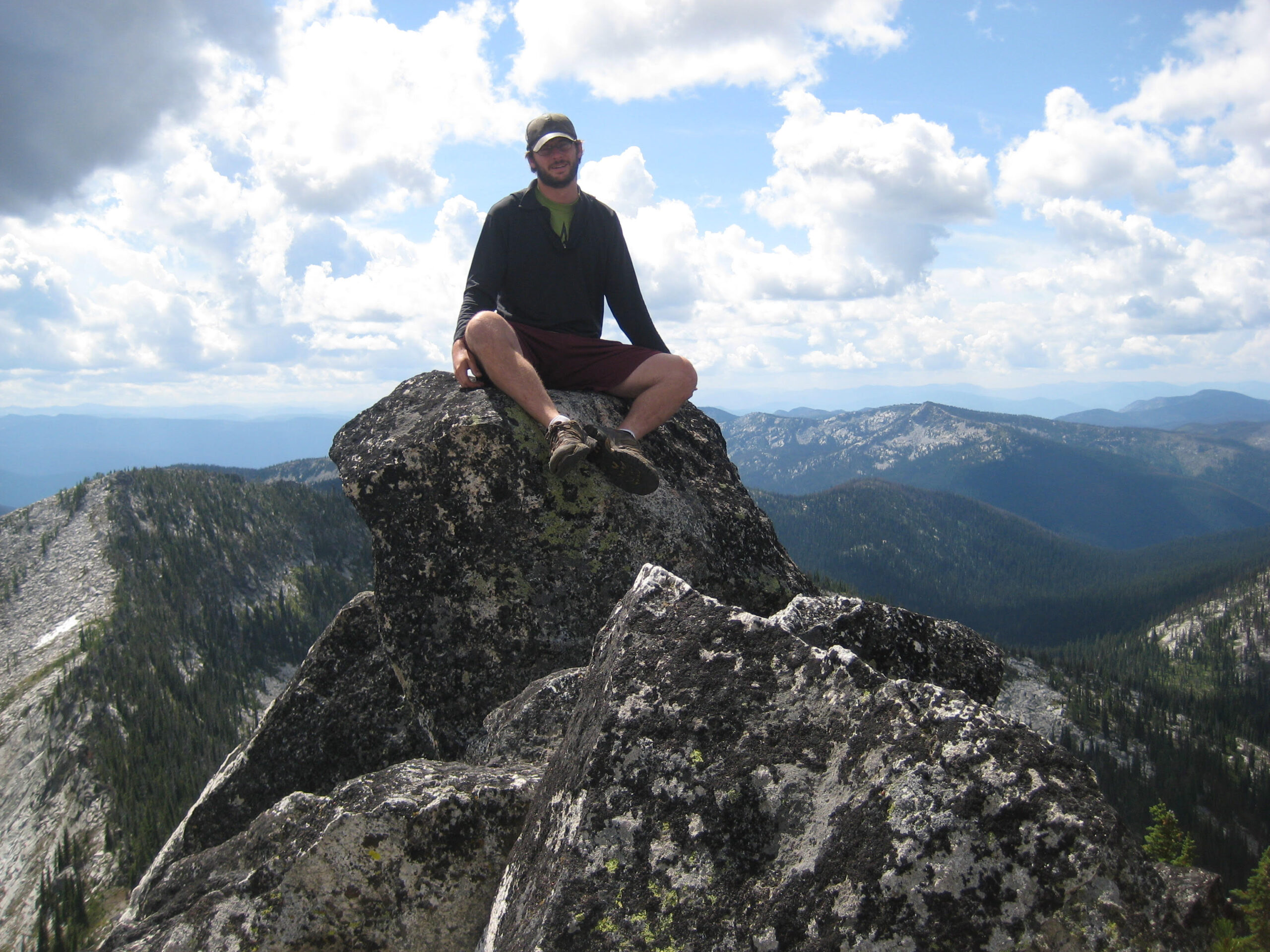
J.P. Kemmick
J.P. Kemmick has had past work published in The North American Review, Carve, Barrelhouse, and the first issue of Pacifica Literary Review, among others. He works in urban ecology restoration and lives in Tacoma, WA with his wife and kids.