
Cutlass Supreme
by Richard Breyer
Howard’s plane taxis up to a three-story glass and aluminum terminal with stadium lighting, a far cry from the Quonset hut and rolling stairways that greeted him the last time he was here. Today’s greeting comes from the cockpit: “Stay in your seats until notified otherwise.”
Three men in ski masks, Policia on their chests and broad backs, move down the aisle, an AK-47 in the hands of the shortest of the three. As Howard sketches him, the officer slows and moves his rifle ever-so-slightly in Howard’s direction. Howard brings his pad into the shadows below the seat back in front of him.
“Venga,” from the back of the plane. The AK moves on.
Howard turns his attention to a woman in the aisle seat across from him, hand at her mouth, eyes wide. He quickly begins sketching her.
The tallest of the three policias leads a man in a rumpled blazer and rumpled sweater off the plane, the man’s shoulders stooped, manicured grey goatee, his lips curled in a smile. Or is it a snarl?
As Howard steps up to a donkey-slow conveyor belt, he catches a glimpse of the woman he sketched in the seat across from him. Her chestnut hair tipped with blond. Her dark glasses catching the strobe lights raining down from propeller-sized ceiling fans.
“That was scary,” she says, taking a step in his direction.
“Hate to think where they’re taking him,” Howard says, recalling the stories of people picked up off the street, out of their bedrooms, classrooms, found dead on the roadside.
“I guess. I try not to think about that,” she says. Her perfume is lilac or mango.
“I’d love to see what you drew, what you were drawing,” she says as she pulls her luggage off the conveyor belt. His luggage rounds the corner, approaching. He lets it pass, pulls out his pad, and shows her his sketches of the AK man, the man with the goatee escorted off the plane, and the piece he did of her.
“Nice,” she says as she pushes her glasses up, resting them on her head and reaches for her phone. “May I?”
He catches a whiff of her perfume again (lilac, yes, definitely lilac) and angles the sketch pad in her direction. She takes photos of the work.
“Thanks,” she says.
Searching for something to keep the conversation going, he finds: “First time here?”
She smiles. “This was my home before the war. Now it’s summers with my grandmother in the South. I like being there, til I can’t live without air conditioning and roads without potholes the size of swimming pools,” she says as she picks up her bag, takes two steps, stops, and turns back to Howard.
“And you? I’m guessing…” She mimes moving a paint brush over a canvas.
He nods and is about to tell her about the priest who became a revolutionary. She turns and exits before he can get the words out.
Outside in the steamy chaos, the newly arrived are surrounded by cab drivers: “Hola. Hola.” “Over here.” “More car, less dollars.” “Fair price, not like these criminals.”
The woman, framed by the open window of her cab, waves at Howard and shouts, “Come visit. Come to Las Marnipiñas,” she says, her voice drowning in the roar of traffic. In the distance, bongos, a high-pitched trumpet, a female voice—Cumbia, Cumbia, Let’s dance the Cumbia.
#
Howard’s hotel room looks out to the city’s towering cathedral and waterfront. A cruise ship the size of an aircraft carrier moves out to sea.
He had decided to come a week early before the memorial service and stay here in the capital center, near the Museo Nacional and, according to Artwatch.com, galleries exhibiting the country’s vibrant, post war art scene. This, he hoped, would lead to paintings that captured the spirit and color of this country that had dominated his dreams since he was last here.
He grabs his backpack and heads for the elevator, sharing it with a woman with painfully red shoulders under a straw hat the size of a boogie board.
“Morning,” he says. She nods, her hat moving the air like a loon lifting off. Outside, diesel mixes with spicy music from open car windows. Teenage girls in pinafores ignore snipping boys in shirts and ties.
As he crosses the street, he spots a fifteen or sixteen-year-old lift a plastic gallon jug to his mouth, take a swig, step into traffic, spit into the air, raise a torch. Boom. A ball of fire. He puts the jug on the curbside, lifts his hat up to the passenger side windows of cars waiting for the light to change. One opens, a hand with ruby red nails, drops coins into the boy’s cap.
The window closes, the car speeds off.
Howard heads down Calle Tercero, across the square to El Prado, the cafe where he and his crew began their days over coffee and eggs scrambled in chilis, bundled in tortillas. Where he conducted many of the film’s interviews, including the one with Susana Ortega’s father.
Dear Mr. Trishman,
I’m the daughter of the priest who joined the revolution after he saw a child shot in the head. It was a very dark time here, still is in many ways. But he was proud of what he did and used the film to show me and my sisters his young self and the war he fought in. After a long illness, he passed peacefully in his sleep, gracias a Dios. We’re holding a memorial and want to include the film. Our copy doesn’t play anymore. Could you send me another or where I can purchase one or, better, bring it with you when you attend the service?
Susana Ortega
He takes a seat at a table in the middle of the room. In the corner in front of a dormant flat screen TV, the only other patron is an old man—hollow cheeks, a goatee like the person escorted off the plane. His attention is on a neatly folded newspaper. A cigarette snuggled between his lips, smoke curling up over his wrinkled brow, adding to a line of yellow imprinted on his forehead.
A young woman—purple hair, Lakers T-shirt—takes Howard’s order.
He fishes out his pad and charcoal, turns to a fresh page and, in a few lines, renders his elevator companion. Then he turns his attention to the old man across the room and begins sketching, starting with his mop-like hair along his bony forehead, moving to his protruding cheek bones, angling into his goatee.
“Picasso?” the old man says.
“We’ll see,” Howard says with a smile.
“Please,” the man says, pointing to an empty chair at his table.
Howard finishes off the goatee, grabs his things and walks across the room.
The man stays focused on the newspaper like a model holding a pose.
“Thanks,” Howard says, and picks up where he left off.
The waitress puts a steaming cup and a plate as far away from Howard as possible, so as not to disturb el artista. But the aromas and the memories pull him away from his sketch pad. He lifts the cup and tastes the same earthy zing that lifted him into his days when he was last here. The egg-chili-tortilla dish is more Styrofoam than the spicy morsels he remembers. He pushes the plate aside and finishes off the coffee.
“May I?” the old man says, picking up the sketch pad before getting an answer to his question. He scissors the cigarette between his fingers, inhales slowly, blowing smoke out of the side of his mouth, keeping it away from the work.
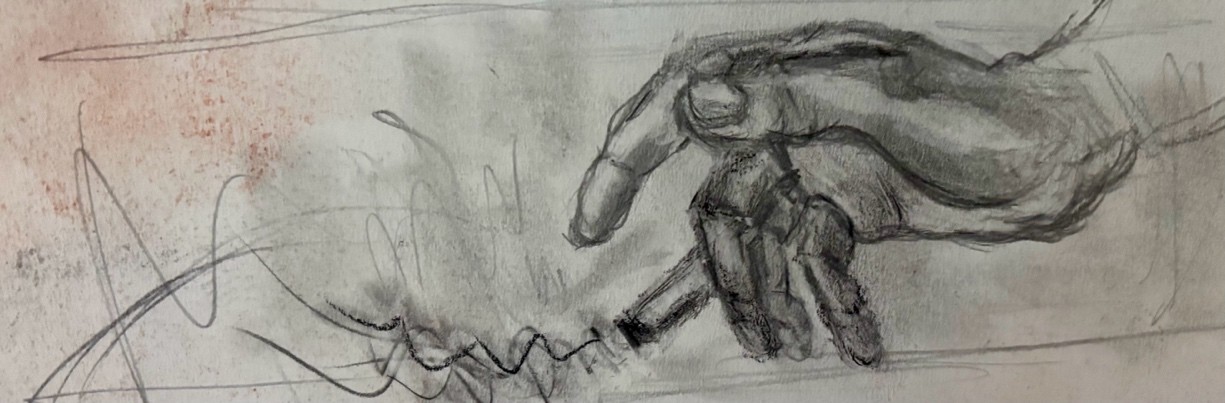
“This pretty much covers the state of things,” The old man says, nodding at the drawings. “Tourists, men with big guns…” He points to the sketch of the woman across the aisle with her hand over her mouth. “Fear. Plenty of fear.”
“And?” Howard asks, nodding at his unfinished drawing of the man—”Where do you fit into the state of things”?
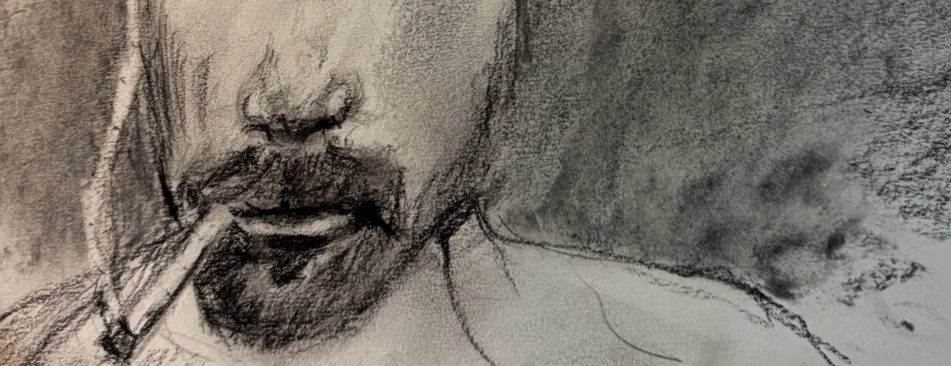
“I chauffeured the rich to and from their beach houses, city houses, and whore houses.”
“I’m betting you have stories to tell,” Howard says.
The old man takes a drag, exhales, follows the smoke as it rises above Howard’s head, lingers, then disappears.
Howard doesn’t push for an answer to his question, something he would have done when he was making the film. He turns his attention to his sketch pad and the portrait of the old man.
“You wouldn’t know of a place called Los, Las Maripin? Something like that?” Howard asks without looking up.
“Yes, of course. Las Marnipiñas. In the south, people are different there, more campesino, hard hit by the war. A place you should visit,” he says, reaching into his shirt pocket, handing Howard a business card.
“What about that job of yours, chauffeuring the rich to their whore houses?”
“And beach houses. Chauffeured, past tense. Retired,” Ozwaldo (the name on the card) says. “Las Marnipiñas, a very interesting place. I’ll take you there. Give you a good price.”
“Can’t. I have a funeral on the tenth.”
“That’s a week from now.”
“I need time at the Museo National and the other galleries.”
“To?”
“Study paintings, sculpture, art that came out of the war.”
“Marnipiñas. Better than any museum. A day to get there, a day to get back. Five days in the village. You’ll see places tourist never get to and what the war was really like.”
A soccer ball bounces off the head of a three-year-old, sending it across the floor to his sister. The boy’s arms end at his elbows, his legs at his knees. A woman in faded green cottons, matching headband tells Howard, who stands next to a camera under a boom pole, that her child stepped on a land mine on his way to kindergarten.
“I have a pretty good idea what the war was really like,” Howard says, emphasizing really. “Keeping those ricos in power no matter who they hurt or killed or maimed.”
“I was a driver.”
“Who was on their payroll.”
“And what was I supposed to do? Stop the car, turn-around, tell the coronel in the backseat what you’re doing is wrong? They’d have put a bullet in my head, left me on the roadside, dinner for wild dogs.”
“You could have quit.”
“And do what? I had a family to feed, two kids. Why didn’t you knock on the front door of the White House, tell your president to stop sending bombs and guns to countries like mine? Stop training soldiers to kill and torture?”
“I made a film about the people of this country, about the victims of the war,” Howard says. “I did all I could.” He knows he is lying. He could have marched, gone to jail, raised money, run for office, painted wall-sized canvases of the maimed and dead.
“So, you came back to finish the job?” Ozwaldo says, nodding at Howard’s sketch pad.
“There’s no job to finish,” Howard says, recalling the sting he felt when he read: Left leaning documentary misses the mark. Liberal self-flagellating. Wants to hand over another country to the Commies. And the canceled broadcasts, empty theaters.
“I’m here to attend a funeral.”
“And?”
“Pay tribute to a friend.”
“And?” Ozwaldo says, again nodding to the sketch pad, “Why the pretty pictures?”
“Why the pretty pictures?” Howard says, weighing whether or not to tell this stranger his story.
“A couple of years ago, five to be precise, after a bout with cancer I picked up paint brushes and charcoal and began making quick sketches on the streets, parks, wherever people gathered. And used them to paint canvases in my studio. The invitation to the memorial fit into where I was being pulled or pushed. Yes. I’m here to pay tribute to a friend, to attend a memorial. But the real reason I came,” he nods at the sketch pad, “is to collect pieces of the puzzle I’ll put together when I get back.”
“I’ll knock off a quarter of my fee. You’ll be back in plenty of time.
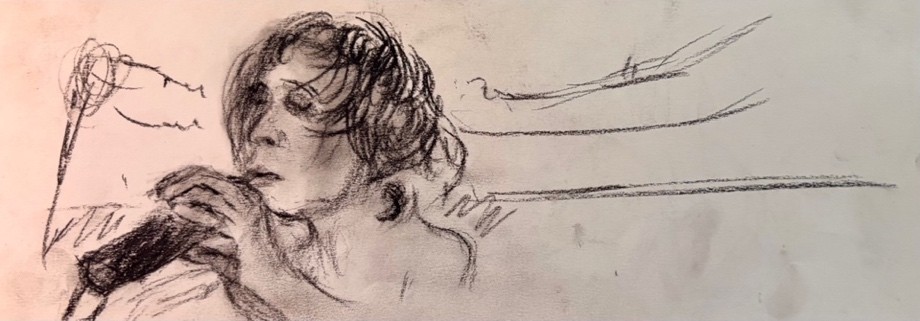
The purple haired waitress, sensing a shift in mood across the room, tries to lighten things up by flipping on the TV on the wall in front of Howard. The screen comes to life. A woman in a loose halter top, hips moving to trumpets and bongos, is phallically caressing a microphone.
It’s the same beat, maybe the same song he heard outside the airport.
#
A yellow Oldsmobile Cutlass Supreme with mangey rust patches pulls up to the curb outside Howard’s hotel. Ozwaldo’s at the wheel in a cowboy hat, cigarette between his lips looking like the Marlboro Man if he had lived past his prime.
Ozwaldo jumps out of the car, takes Howard’s bag and places it in the trunk.
Howard reaches for the handle to the passenger seat. Ozwaldo beats him to it, opens the door, gestures for him to take a seat and returns to his place behind the wheel.
“I need to drop this off,” Howard says, holding up a bag with his film inside and handing Ozwaldo the envelope that had carried Susana Ortega’s letter, her address in the upper left. “Hope it’s not too far out of the way.”
“No problem,” Ozwaldo says after a quick glance at the envelope.
He pumps the gas twice, turns the ignition, slips the car into gear and moves into thick morning traffic.

In the adjacent lane there’s a pick-up with a pile of soil in the back, two men sitting on top, their skin, Howard notes, the same color as the earth under them. Ozwaldo crosses lanes, squeezes in front of the truck. The driver slams on his brakes, avoiding a collision by centimeters, blasts his horn, raises his middle finger. Ozwaldo catches the gesture in his rearview, smiles like the Marlboro Man after that first, satisfying drag.
They head down a street, pot-holed, the surface of the moon, lined with dusty, exposed cinder block buildings like the one that housed the church of La Familia Sagrada where Howard and his crew filmed an old woman whose eyelid fluttered like an insect caught in a spider web when she told her story. “We tried to run. They were too fast. They came in helicopters. My daughter was pregnant. They cut her open.”
Ozwaldo turns onto a smooth, two-lane highway that leads to a line of high rises, and parks in front of one of them.
“Here we are.”
“You sure?” Howard says.
“Yes. I’m sure.” Ozwaldo says, pointing to the numbers above the entryway.
“I can’t believe he ended up here,” Howard says, more to himself than to Ozwaldo.
But Ozwaldo gets it. “It doesn’t fit into that neat little box. Right? Revolutionaries shouldn’t live in building with tennis courts and intercoms.”
“That’s not what I meant,” Howard says in an angry voice, hiding that that’s exactly what he meant. Revolutionaries shouldn’t be living in building with tennis courts and intercoms.
And when the granddaughter of the priest who became a revolutionary greets Howard in a KFC uniform, he’s touched by the same anger. He’s angry at Colonel Sanders, at Ozwaldo, at the polite young girl standing in front of him.
“Give this to your mother,” he says, handing her the film, ignoring her question of “Who should I say gave this to me?” as he walks back down the hall to the elevator.
When the doors part, he’s face-to-face with a woman with the same electric eyes as the priest who became a revolutionary. “Mr. Tishman,” she says stepping out of the car, hugging Howard, surprising him. They’ve never met.
“How did you know it was me?
“The photos in the papers. When the movie was on the TV,” she says.
“Ah,” he says, pleased to learn that his work was shown in the country. He wonders if it was reviewed favorably.
“I just dropped the film off with your daughter, wanted to make sure you have it. I’ll be traveling before the service on the tenth.”
“Traveling? where?
“The South. Las Maripiñas.”
Her face darkens.
“I heard it’s interesting, a place to get to know,” he says.
“No. No, you shouldn’t, don’t.” Susana says. “That’s where the communists are, that’s where they launch their attacks. It’s not safe, especially for someone who looks like you.”
He laughs, imagines he’s being kidnapped, blindfolded, tortured. He wonders why he finds this amusing.
“Stay for a lunch?” Susana says.
“Can’t. I have someone waiting,” he says, turns, pushes the down button.
She grabs his arm and hands him a business card.
Susana Ortega
Chase
Branch Manager – 678229
“Call if you need help…I know the right people.” Howard hears the thump of the soccer ball bouncing off the head of the child who stepped on a mine on his way to kindergarten.
Susana’s takes a step closer and speaks in a whisper which he finds strange—the hallway’s deserted.
“Near the end. He was very weak. I had to put my ear up close to get what father was saying. Just before his last breath, he said: ‘I should have stayed a priest.’ Of course, I won’t say this at the memorial. But I wanted you to know.”
The numbers counting down the floors are a countdown to something, Howard isn’t sure what. But he is sure he has to get back to his studio, back to terra firma. He’ll pay Ozwaldo what he promised him, send Susana a text about a family emergency or a problem with his visa, and he’ll take the next flight out.
When he steps into the lobby, he hears an annoying car horn—Beeb…Beeb….Beeb….Beeb. And when he steps outside, he discovers it’s coming from the Oldsmobile. Ozwaldo, bare headed, bent, leans on the hood of the Cutlass.
“Fucking kids took my cigarettes and my hat, my favorite hat…tried to get my wallet,” he says, blood raining down on the Cutlass’s hood ornament.
“What can I do?” Howard asks.
“There’s a towel in the trunk.”
Howard finds it under framed photos of square men, chests plastered with medals, the peaks of their hats masking their eyes.
“You’ll have to drive.” Ozwaldo says, one hand holding the towel to his face, the other handing Howard the keys.
“Can’t, I don’t have a license.”
“I’m cut deep…nose’s broken,” Ozwaldo says opening the passenger side door and slipping in.
Howard doesn’t move.
Ozwaldo rolls down the window and shouts. “Get in. Please,” his voice muted by the cloth he holds over his bloody nose.
Howard reluctantly walks around to the driver’s side, gets in, inserts the key into the ignition but doesn’t turn it.
“I haven’t driven for…I can’t remember when.”
“Straight ahead, first left. I’m losing a lot of blood.”
Howard turns the key. Nothing happens.
“Pump the gas twice, then the key,” Ozwaldo says.
Howard does as he’s told. The engine comes to life. He shifts into drive, steps on the gas. The car grindingly inches forward.
“Brake….Emergency…” Ozwaldo says, pointing to a lever near the driver’s side door.
Howard releases it.
The Cutlass lunches forward, hiccups, stops, then speeds down the street, turns, tires squealing, leaning like a catamaran into a heavy wind.
Richard Breyer
Richard Breyer writes both fiction and non-fiction. The genesis for many of his pieces comes from his travels to places like India, Colombia and El Salvador. His current project is a ten-part short story collection. Richard has been a Fulbright Scholar to India twice. He teaches film at Syracuse University.