
Undocumented: the True Palouse
by Rho Weber Mack
The true, nearly forgotten story of M/We is best told around a pine log campfire out on a rise on the Palouse, where the long stem grasses and the mineral soil still hold the old memories. Those who have heard the retellings will recite for your skeptical ears how, in the long gone days before our time, on a certain high ridge of the Bitterroots, the woman M/We herself lay resting with her face against the sky. They will tell you how, if you looked rightly, you could see the wide flat ledge of her forehead, the craggy features, the mineral chin, the pine-peaked breasts, the rounded belly. They will suggest that if you had a pure and steady heart you would see how the spring of sparkling, nearly radiant water flowed clear and cold from between her thighs.
Climbing her heights, you would see the lichens that mottled her features, the mosses greening the cracks and folds of her body, the embrace of roots. And they say that if you could conceive the whole mighty body of her as you clambered among the lichens, she herself would enter your mind and meld her presence with yours, whispering M/We, M/We, M/We.
While the continental ice sheet ground down the oldest mountains, the forward edge of the glaciers bulldozed rubble walls of boulders and ice ahead of the meltwater. Forty times, the rising meltwater broke through the dams, and the roaring flood ripped a wide raging path on its way west. Forty times, the churning blast of rock and ice scoured the wilderness and all that stood in its path to become the Channeled Scablands of the inland northwest.
When the last of the floodwaters subsided, the debris left behind lay splayed like bones across the landscape. Then, they say, he himself stood on the high spine of the continent, toe bone clicking to metatarsal, knee bone connecting to thigh bone, the bristling stack of vertebrae rising columnar from the great bowl of the pelvis, the neck and skull riding high, and his wild mane touching the clouds. He, the first of his kind, strode forth to discover his beginnings, and his name was also M/We.
But his bones were restless, so that on a fresh new morning he journeyed west by west, beyond the Tetons, the Hoodoos, the Bighorns, the Sawtooths, the Lost River Ranges. And when he came at last to the Bitterroot Wilderness where she lay sleeping on the high ridge, she stirred at his presence, and the earth shook, and the boulders that discretely hid her limbs tumbled away. Then the woman M/We rose up to her feet to greet him, and when she stood, her head nearly touched the clouds, piled high as they were with promise of rain.
“Welcome, my Other Beloved,” she said. And they embraced, mineral and water, M/We and M/We in the dawn of the world. It came to be that the two of them married, and became one name, and they had many children. Indeed she herself birthed thousands. How this is possible I cannot tell you, but this is an old story best told out on the Palouse in the dark, by a low crackling fire which casts moving shadows but no light.
It is said of the other M/We that his hands and his heart were one, so that anything he thought to do was done. Being of the earth himself, he spoke to the rooted and the crawling and the four-legged in the common language of silent knowing. He himself, it is said, led the wooly mammoth to a narrow valley in the season of deep snows and hunger, yet it was not he alone carrying the spear. It was the many moving as one, reading the lay of the animate earth and one another’s movements as they circled and crouched and ensnared the great one. It was a good kill. They say M/We fed the whole encampment that winter, and even all who came with hungry mouths to verify the feasting. Such was the greatness of M/We.
And it is said that it was not she, M/We, alone bearing the future, but all who came after her, daughters of earth and water, striding across the wide green lands among the cannas and the bracken, the elderberries, the huckleberries, the snowberries, and the kinnikinnik. It is said that her children and her children’s children spread across the land alongside the moose, the elk, the pronghorn, and the cougar. And it is said that they all held council together in the language of the listening heart.
#
Memory rises like smoke from the storyteller’s campfire, and the teller recalls how M/We, she having nurtured so many, turned at last to nurture herself. How she lay to rest in the landscape, her rounded belly upturned to the stars, and her backbone buried in the earth. How, in the long meanwhile, the glacial loess lay drying, drying, drying in the winds that swept from the high cold mountains. How the winds lifted the rock flour of the ice-carved mountains and carried it westward, a mighty dust of glacial remains. How the dust of long-gone mountains settled like windblown ash, drifting into dunes of undulating waveforms across the wide Palouse. How the prairie grasses and wildflowers seized the shifting dunes in a tangled weave of roots. How the swells and swales settled into a vast rolling grassland with copses of cottonwood and groves of red cedar in the low wet places.
#
But tonight, by firelight, the Teller remembers an older story of the Palouse. She remembers that it was M/We herself, and her daughters, and her daughter’s daughter’s daughters who lay their fecund bellies, greening with life, toward the skies of a new millennium. Across the landscape north, south, and westward for nearly four million square miles, the fertile bellies mounded and nestled, awaiting the time of birth.
“And if you yourself stand barefoot and hatless on the living horizon,” the Teller continues, “you will know that this is so.”
#
So the children of M/We spread among the valleys of the sun, and the deep cool creek bottoms, and the high plateaus of the wild places. They were small beings, only as tall as five-year-old saplings in the understory, and for a time, it is said, they remembered how to follow the seasons and the land in a sacred manner.
Words came later, and so the world splintered into pieces. The language of shared being was no more, the whole having been divided into numerations, delineations, dominations, and petty powers. The swelling bellies of the Palouse lay submissive beneath the blows of small men whose hearts had shrunken into hard pits of bitterness. It was a world of broken things, bursting into rubble like the dams of meltwater that had once scoured the landscape. The old ways lay shattered like the splinters of wilderness felled by the ax.
But by then he, that other M/We, was already high up in the mountains, away from the chatter of cheaters and takers. He was also quite old. And they say that in the winds of geological time, he, M/We, lay down his long bones and his short bones along the high mountain ridges of the uplands, shattered and splintered as he was into the broken pieces of you and me and them, us and ours and mine. And they say that where the pieces of his once-fearsome being lay, the wilderness spread and rose like thick hair on the chest of a mighty warrior, and there were no finer forests than the grand fir on the shoulders of those peaks rising into the clear cold air.
M/We and M/We were no more, having bequeathed the sustenance of their bodies to the earth. And it ripened and rooted across the wide spaces and the side traces, it spread in the long grasses across the fertile bellies of the prairie dunes. On a summer afternoon, when the westerly breeze came up, the wind rode the bellies of the landscape, and in the undulation of grasses the wind wolves ran wild.
#
On a late Sunday morning, the muddy 4WD diesel snarls into the parking lot of the grocery outlet. He is a small man, broken by brutal work, and she is a small woman, whose heart is pinched under the sagging bloom of her breasts. The children shrink from both of them, and become even smaller. Inside the store, the mother mutely selects the grocery cart with the red plastic fire engine nose and the boy, the youngest, mutely claims his ride. The small man points the sisters to a table in the cafe where he can watch sports on the big flat screen. He buys himself a coffee, and the older sister a soda. The younger sister, in a stained sweatshirt, looks at her empty place at the table and chokes back tears until her nose runs wet.
“Wipe your nose!” The small man snarls, and his strong flat hand smacks her smartly across the face. She howls, takes a jerky in-breath to howl again, an in-breath, a howling. This has happened before, because he ignores her. And you, sitting at the far end of the cafe—you, the only witness to the unbearable sound looping, know that this will happen again.
You stand. You do not interfere, because you know it would only get worse for her later if you do. You look to meet the young child’s eyes, to slip a quick nod of sympathy, but the child is too filled with howls to see beyond her own tears. You look to meet the father’s eyes, and when he finally notices you, a witness standing wide-eyed, he beams a sweet friendly innocent smile. He is a very small man.
The mother drags a shopping cart, piled with boxed foods, to the edge of the cafe. She too ignores the noisy nuisance of the middle daughter. They huddle into coats and straggle out across the parking lot under a mean wind. You watch them go—the daughter still wailing, the older sister at a careful distance, the bouncing boy, the father ahead already jingling in his pocket for the keys, the mother behind, pushing the cart, all growing smaller until they reach the truck and disappear inside.
The truck heads north from town, shrinking away on a thread of road that leads north to cool mountain lakes, but he is not heading there. The howling child in the middle seat rocks, seasick, at the rise and fall of the rolling dunes. The truck noses north to a back dirt road where, on an open flank of heat-wilted weeds, a former RV is racked on cinder blocks, shadeless and open to the elements.
Across the wide Palouse, the rounded mineral bellies shudder, and the trees scratch themselves. As the truck shrinks away to the horizon, you pluck the small man from behind the wheel and put him in your shirt pocket, where he bites your chest until it bleeds a river of dark blood. To staunch the flow, you press the howling daughter against the small sad stone of your own howling heart. In your ears the unbearable choke and wail rise like a storm.
#
In the summer heat, the red glow of the storyteller’s fire fades into a dying dull sizzle, but the slow lick of blue flames hides deep in the coals.
It is Monday afternoon out on the hot Palouse, where across a million square miles of dusty dunes the dry wheat bends in the furnace of the sun. For the small man, driving for the harvest crew is his lucky season. It fills his pocket with summer employment, and for a time he can feel strong and mean. Today he is in the big cab, riding the Case harvester with the AC on and the radio twanging while the header eats up a forty-foot swath of wheat in his path. Twenty feet on each side of him, slicing. He rides that Case over, down, and around the high mounds, edging the wind scoops and leeward drops of the wheat fields of the Palouse. God-seat, goddamn.
He doesn’t hear the squeak of the broken bearing which is beginning to drip hot oil on the dry wheat stubble behind him. Riding the harvester out to the far side of the field, he glances back across the rise of the dune to see a white cloud rising, as it will when a Case monster chews through a dry dusty field. Later he notices that the dust cloud is bigger, billowing, blackening, smelling sharply of smoke. Then he knows, even before he sees the trail of fire behind him. On a windy day, which this is—in dry hot conditions, which this is—a wheat field fire can travel nearly a mile out in one quick hour. And his truck is parked roadside in a field two farms back.
He cuts straight for the road, rips across the field, nearly topples the harvester in his panic, which bends the left spreader arm so that when he does flip, trying to cut across a drop in the dunes, the bent arm is not there to stabilize him. He is still pinned inside the twisted cab with the AC running when the fire comes.
Across the Palouse, north, south, and westward, the trail of fire blooms red and smoky. The bellies of generations writhe in the lick of flames, and out in the line of wind the unwheeled RV explodes in the firestorm. Later, in the news, the tone is graphic but not surprised.
#
Up in the Bitterroots, where even along cool stream bed embankments it is fire season, the Teller scoops cold creek water over her campfire and stands out along the bank to breathe the scent of the wind under a waning moon. She remembers M/We, and suddenly, sharply, she knows how the story will go on—how, when the howl of this child of the children’s children’s children is no longer heard or noticed or grieved—how then M/We herself will rouse from trembling dreams to shake off her long sleep, and her vast bellies will shed the dust of millennia.
On that day, the Teller sees—in the round of time that is not past nor future but forever now—how on that day and in that time, M/We stands once more, with an old woman’s stubbled chin, her feet embedded in basalt, but her head still touching clouds. To quench the child’s unbearable howl, M/We summons the Chinook from the superheated Pacific, and the Chinook, a living being, shrieks northeasterly, wringing out its warm rain on the coastal ranges to fling itself across the Palouse in a hot drying wind. So summoned, the Chinook peels the matted roots of wheat and canola from the loess dunes and tosses them aside like ragged carpet rolls, rips the trees from the rocky rises and the farmhouse breaks. And the loess itself rises again to blind the air, blowing easterly now toward the the Lost River Ranges, the Sawtooths, the Bighorns, the Hoodoos, the Grand Tetons, rising on air current to ride the spine of the continent itself.
On the Palouse, the red-black columns of basalt, now unburied, rise and clatter, chattering like broken teeth when a hard hand smacks an open face.
#
And the Teller, whispering now in the dark, will say that when this time comes, M/We will reach with newly roused desire for the other half of herself—for stone on bone, for stick stacks stirring, for raw wild wilderness. And on that day he, M/We, too will rise from the broken Earth with the softened crags and pliant features of an ancient one, and the two will merge in a storm of entanglement—M/We whole once again, singular and complete.
High in the Bitterroots, the Teller scratches through the campfire in search of hidden hot embers. From the southwest, the sharp winds of the Chinook swoop down to snatch the burning coals and scatter them across the steep dry rises.
This is the nearly forgotten true story of M/We in their early days on the Palouse Prairie, as the Teller remembers it. But, even for the Teller, the ending remains unknown.
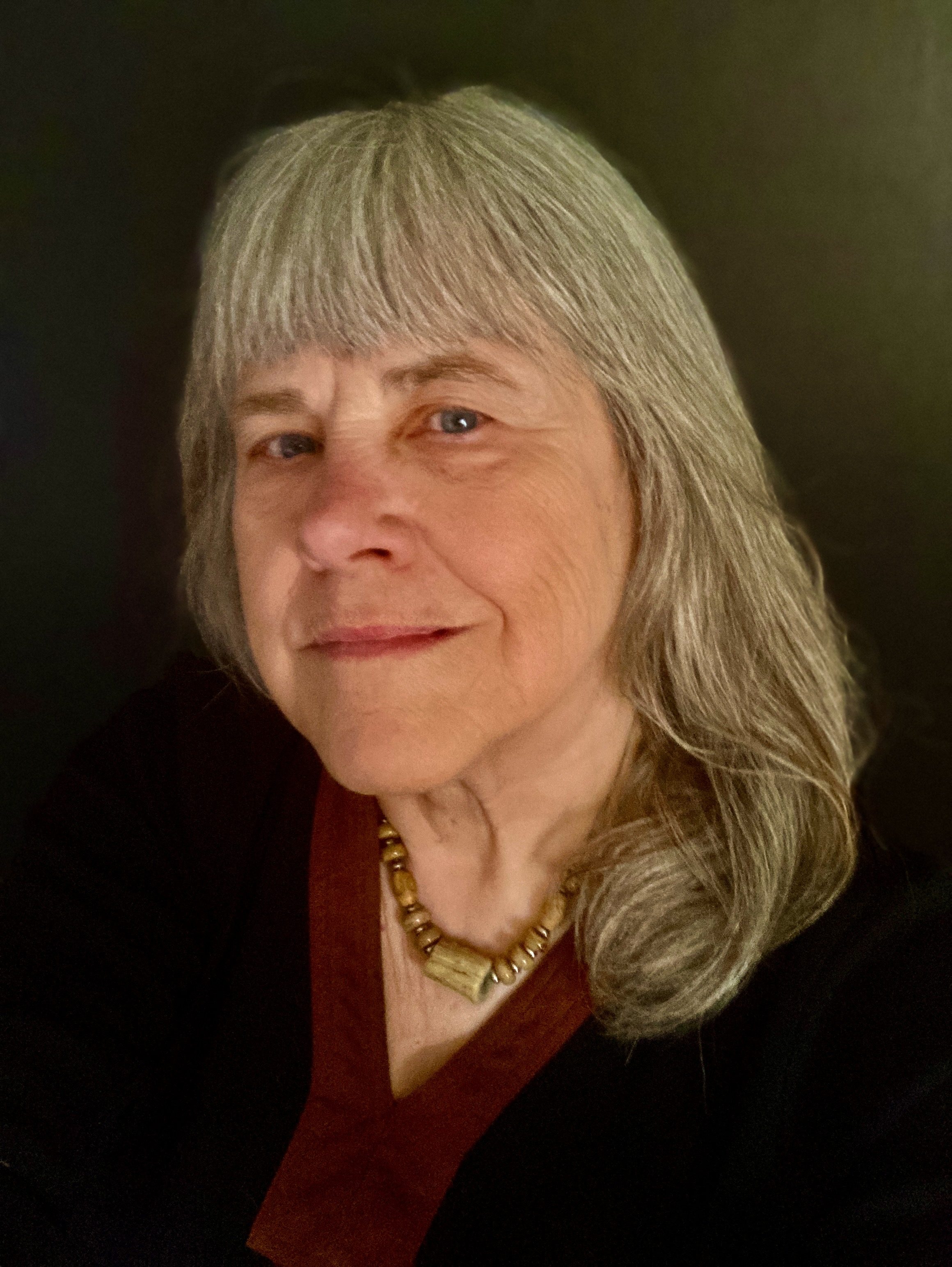
Rho Weber Mack
Rho Weber Mack once earned an off-label degree in ancient human history on road treks in East Africa and Middle Europe, which still informs her long view toward home. Her work has been published in Ploughshares, Best of Carve, and Epiphany, among others. Currently she writes long-form fiction, shorts, and creative nonfiction from a mountain valley in northwest Idaho. She is working on multiple projects related to her just-released young adult slipstream novel, The Thin Door.