
Limerence Milkshakes
by Didem Arslanoglu
Ruby and I had different epistemological approaches to surviving Los Angeles, which somehow brought us close as roommates despite being, in most other respects, incompatible people—my goals, straightforward, to make something of myself as a comedy writer despite having no leads, freelancing for fast food companies as a copywriter, which was somewhat like writing and felt akin to dark comedy. Hers, to be a public spectacle, to finesse her beauty and eroto-social mores, and through it, acquire sugar daddies, advantageous dates and friends, industry connections, anything to propel her career.
She filmed lengthy GRWMs before clocking in to her hostess job at Fleming’s, sharing explicit sex and dating stories, doing makeup tutorials, ASMRs, and late-night mukbangs, a jack of all trades, though especially skilled at tapping her acrylics on plastic cartons and whispering impishly, “Welcome mummummum to my page age agæ aæ.” Occasionally, I accompanied her in sucking down Carl’s Jr. milkshakes on TikTok Live at 2 AM. She’d proudly tell her 62,000 followers that I “wrote the milkshake writing on the Carl’s Jr. app,” and like triggered wasps, they foamed through the chat: We want the chopped one off camera!!!! Can you auction your panties on TikTok Shop?
When I felt like being brave, I straightened my spine and told them I not only wrote for Carl’s Jr., but also for Burger King and Jack in the Box. Sometimes I threw up cherry after all the hate comments. I didn’t know how Ruby handled any negativity. They called me a sexless woman with the disposition of a sea anemone and the worst they said about Ruby was that her nose looked like fresh Taro root if you squinted hard enough or had astigmatism. I considered moving back to New Jersey.
The first year we lived together was in a ratty one-bedroom in North Hollywood. The sidewalks flanking the complex reeked of dog shit and piss, baked permanently into the fibers of concrete by year-round dry heat. By January, I couldn’t afford my car payment and sold my Prius for $2,500 and began taking the bus, sometimes borrowing Ruby’s Jeep when she worked from home. I was pleasantly surprised by her generosity.
When she worked from home, she recorded verticals of herself for vague international media companies advertising soft plum candies and eyelid tape and vibrating plates, sometimes for hours on end, leaning against the wall with her ring-light toggled to 100% brightness.
“It’s all very cultural,” she said once, showing me the twenty minutes of ad content she’d recorded that day. I wondered if her eyes had always been that green, like absinthe glimmering in a pond. “Americans want to see tits and ass. They want to know you own a vibrator and ate red meat sometime this week, while the Chinese want to feel you have a heart rooted in puritanism and can sell lychee candy in bulk to people with family values.”
“Do you think you have family values?” I asked her, though I was more curious if she owned a vibrator.
“I think so,” she said, pointing to me, herself, and our sofa. “This is my family right here.”
Our sofa was a 1980s Serpentine, a Vladimir Kagan gifted by one of her daddies, Lavi, who funded her interior design obsession—the guts of it, however, mottled with nickels and loose sugar from peach rings and miscellaneous receipts. That was our doing, not Lavi’s.
“There are dead children in this sofa,” she said, prying apart the cushions. “See?” She pulled out an old tissue. It was clumpy with a gooey something hardened up in the center. “These could be our babies if you want to do the carrying.”
I struggled to play along. I thought maybe she was trying to test our closeness, how close I felt to her, if it was similar to how close she felt to me, which didn’t feel very close at all. She didn’t know my last name or what I did during the day, or that I wouldn’t appreciate her having sex on our sofa, but she joked about IVF.
Though she knew my answers to her dumb hypothetical questions, like, what would I do if she joined a Russian circus—“I don’t know? Are you still covering rent?” would be my response, and it’d make her very angry that I always dragged capitalism into the scenarios. Or, if I’d break into Oprah’s Malibu beach house with her in exchange for a split-scoop of Salt & Straw, to which I said maybe, depending on what was inside the house and which seasonal flavors were available, and later she’d admitted it was a joke scenario because Oprah didn’t have property in Los Angeles anymore.
At the end of our days, if she wasn’t out with daddies in Brentwood, we’d eat fistfuls of generic cheese puffs on the sofa and watch Love Island. We deliberated which reality TV personality we’d put to the death, if we had to, meaning the circumstances were dire and we had to save each other’s lives, but could only do so by eliminating one of the 22-year-olds. We hadn’t even liked each other very much, so it’d just been a decent way of bonding over our general nihilism.
I’d said Marcus, the 5’6″ one, not because I thought short men needed to die, but he was one of those dog people who put down cats in the same breath, cat haters, who I detested.
She’d said Tony, because he was a Republican, and then she mulled over it some more, and I thought she might change her mind and say Marcus (which would’ve elated me, I would’ve suggested we adopt a cat), but then she said that Tony, the name, reminded her of Anthony, which reminded her of Luigi.
“Are those all supposed to be Italian names?” she’d asked, and I shrugged even though I wanted to deep fry her big fat head in a basket of hot oil when she wasted my time with questions, blathering about liberty cabbage and Mormons getting labiaplasties. Then she kept saying, “I want to ride his face.” As in, Luigi’s face.
Ruby thought she’d have really adorable-looking babies with Luigi Mangione, sometimes blending their faces in one of those AI apps that generated images of your future children if you procreated with Justin Bieber or Hillary Clinton or a Neanderthal. It was always the worst day of my life when she’d appear out of nothingness to wag her phone in my face with a blurry screenshot of their AI-generated children.
“I want to ride his face, I want to ride it, I swear I’m going to go up to Brooklyn this year and ride Luigi Mangione’s face and buy him three hundred packets of Skittles from the vending machine and then ride his face again.”
“Good fucking lord, bitch, fine, but can you shut up about it?” I asked, and even sort of yelled it, which she thought was hilarious, breathless for a second when the cheese ball slinked down her windpipe. I hadn’t made anyone laugh in maybe a year or more. The real problem was that I’d fallen in love with her.
In November, Ruby started seeing a health-conscious daddy named Ronzo, who, for three weeks, arranged for her daily cerebrolysin injections because Alzheimer’s ran in her family and Ronzo wanted to be proactive. He sent nursing students in polyester scrubs who wheeled small machines into our apartment. She put zucchini slices on her eyes and blasted the Stardew Valley soundtrack in the living room while they shot peptides into her bloodstream.
Sometimes, they’d do the injections in the evenings, and I’d be cooking a stir-fry or something when she came into the kitchen to flick the empty cerebrolysin syringe in my face and start asking hypotheticals: “God, I missed the sound of that, can you believe I used to be addicted to heroin?” She was not very good at acting. “If you could do heroin once with a fifty-fifty chance of dying, but you’d get $3 million afterward, would you? Okay, now imagine I’m the one doing the heroin and you get $10 million if I live. Would you let me? And there’s still a fifty-fifty chance of me dying, by the way.”
I asked her to please never do heroin and she said nobody cared about her the way I did. Then she leaned over the stir-fry to kiss me softly on the cheek.
In December, I took eleven homosexuality quizzes online. Half of the results were inconclusive, pointing to bisexuality or demisexuality, which I wasn’t convinced of. Demisexuality, I felt, was akin to having a middle name. I paid for two in-depth analyses from real lesbians and both said I seemed confused, that one instance of romantic feelings or lust didn’t necessarily signal gayness, but some experimentation might do me good, if not a preoccupation which didn’t involve Ruby.
“Like a hobby?” I asked them. I had no hobbies.
When Ruby’s follower count spiraled from 62,000 to 3 million in just over a year, I still hadn’t acquired any hobbies or writing gigs, but worked as a cashier at Yogurtland. I resented her fans, horny bozo gooners and college-aged girls who concealed themselves behind lamp posts in my job’s parking lot to sneak photos of her when she picked me up from late shifts. Sometimes, they came in for yogurt and asked me to deliver things to her, varying objects— envelopes bulging slightly in the middle, post-it notes with hastily scribbled Instagram handles and SoundCloud links, five-dollar bills, collectible keychain plushies. I wanted to make a bonfire of their gifts and dox their families using their credit card information, and when I consulted the lesbians about that, they said I might be having a nervous breakdown.
“You should really just enjoy the Labubus,” the lesbians said. I cursed the lesbians. They knew nothing about shepherding a young woman into her sexuality, helping her figure it out. Or cure it. They asked for a flat rate, so I figured they were beginning to use me because of my proximity to Ruby and blocked them.
It was Los Angeles, after all, which is what Ruby always said. This was the place for romantics and creatives, for people who felt in their heart of hearts that they were special and meant for fame and would do anything to get it, and she couldn’t neglect her fans, even the crazy ones. I needed to hone in on it as well, is what she told me, that if I was going to “make” it as a comedy writer, I needed to go knocking on Larry David’s door or prostitute myself at the 30 Rockefeller Plaza, but she didn’t want me to leave her in LA for New York City. “The water is too soft there and messes with my hair,” she’d said. “So we can’t go until they figure that out.”
She told me to quit my job in the Spring because it was making me unlikable, so I did. She was paying for everything then and while I wasn’t making or saving money, I didn’t spend anything either, so mostly it felt like I’d disappeared from the fabric of American economics.
I’d known Ruby for one year and six months and somehow agreed to attach myself to her tailbone until the day I croaked. I couldn’t understand my growing helplessness in the face of her decision-making. It was all happening too fast, I couldn’t catch up.
I assumed my honesty came off as refreshing for her, mainly because she was chronically pissed at industry peers, bloat-maxxed opportunists intoxicated by their own butt gunk—we’d officially acknowledged she was in the industry by then because she’d amassed an additional 7 million followers and ushered us from our one-bedroom in North Hollywood to a luxury condominium in West Hollywood.
While I no longer appeared in her late-night live mukbangs, I still accompanied her on weekend trips to Palm Springs and Ojai, driving her aimlessly around Melrose, stopping at drive-thrus for sugary frappuccinos or designer boutiques for $650 rayon dresses. I filmed her try-on hauls and storytimes. Sometimes she asked me to write scripts for brand deal videos because she pitied me, throwing a bone at my writing goals. We edited videos over long brunches in Malibu, sharing Cobb salads the size of adult faces in our matching Grandfunk sunglasses, dodging her fans. They had flouting boundaries and approached us anyway, asking her for selfies in their self-effacing pitches.
I was failing career-wise but Ruby did not mind, her only expectation of me to remain a steadfast friend, to crawl under her duvet with her on some nights after invasive run-ins with TMZ or an ex-boyfriend bad-mouthing her online, to eat Pad Krapow and pints of ice cream with her on the floor and watch Johnny Bravo and strip away any verbal filler for the sake of honesty, to say “No” firmly and often, and poke somewhere into the mushy part of her chest, her fears.
I adopted an Irish Wolfhound shortly after moving to WeHo and named it Haggis. I unblocked the lesbians to ask if what I’d done was manipulative—I’d only ever been a cat person, but knowing Ruby liked dogs more, I hoped she’d feel responsible for Haggis and me, eventually viewing us as her nuclear family. Nothing made me feel close enough. I pondered faking a diagnosis. Lupus, or kidney failure. I imagined Ruby taking me to a nephrologist three times a week, four hours each visit, sharing kisses in the dialysis room. I dreamed of roaming in her mouth with my tongue while the machine recycled and cleaned my blood.
“You are enough,” the lesbians told me over e-mail. “You and Haggis are enough as is.”
I decided I wasn’t gay that April and agreed to go on a date with one of Ruby’s influencer friend’s ex-boyfriends. The man looked decent under Nobu lighting, but I could only pleat fleshy tilapia between my chopsticks and think of Ruby’s limpid skin, the glazy Anago of her sun-kissed shoulders in August, how her lips and cheeks flushed like fatty bluefin toro when our AC would go out in NoHo. He asked me one question the entire night: how I met Ruby, and because I didn’t ask him any questions, we ate in silence and never saw each other again after the date.
By June, Ruby had a new boyfriend, a rapper named Greg who went by “Lil Gangrene.” He’d landed at #16 on a Rolling Stone “20 Rappers to Watch” list earlier that year. Sometimes, he airplayed his beats on our TV, and she’d text me to come out to the living room and listen, give him feedback since I, too, was a “Creative.” Though when she declared me a Creative to others, it felt accidentally derogatory. Mostly, I couldn’t focus on his songs because I was too uncomfortable being around them in the condo.
Shortly into the song, they started eating each other’s faces, last it’d been to “bb lambo,” an ode to Ruby’s new orange Lamborghini Revuelto—SKRRT OFF IN MY BABY LAMBO, AYY, SKRRT OFF IN BABY LAMBO.
It made me nauseous hearing them kiss, knowing he had such unfettered, almost casual access to her, but when I got up to leave, Ruby would open her eyes and look into mine while Lil Gangrene’s were closed. I looked away and pretended to nod along to whatever song was playing, give them space, but never resisted for long and looked back. Lil Gangrene would be under her shirt, pinching her nipple to the beat of “bb lambo,” and she’d still be watching me through her batty eyelashes.
I cried often that summer. I thought I would move out in the fall and see Ruby only occasionally, or go back to Jersey, because I wouldn’t be able to live elsewhere in LA without Ruby thinking I hated her guts.
On the nights that Lil Gangrene didn’t sleep over, she came into my room without knocking and crawled into my bed and spooned Haggis and me. That was my favorite arrangement, though I also liked when she laid between us. Sometimes, she moaned in her sleep, burbling about things I couldn’t decipher, like frog legs in butter and jam or the gift shop.
“Mongey,” she mumbled, reeky morning breath escaping from between her lips. “I lobu it. Moneky.”
She never remembered her dreams, so we joked that in slumber she lived an alternate life in a prehistoric, jungle-drenched Los Angeles as a monkey with a monkey family. “I think I’d actually come back as a monkey the second time,” she’d said, “but only if you were one too.” She pretended to pick at the skin tags and moles on my shoulders, grooming me. “Monkey,” she called me.
Ruby was the main contributor to my loneliness in which I couldn’t shake. I dreamt of reality television nights again, or when she asked me questions I once found so stupid, like, “What would you do if you found out I was a government-issued AI clone?” And before we moved apartments, “If I had to legally marry one celebrity to save your life, who would you choose for me?” For me, she’d said, “Carol Burnett, not because I think you’re a lesbian but I think you two would have a lot of fun. I guess I wouldn’t want you to be with someone who makes you laugh more than me, though.”
She hadn’t made me laugh in months, but if I thought about it longer, it’d been much, much longer than that. I knew she wanted me to pick Luigi Mangione for her celebrity marriage, and I felt very grateful all the time that he was locked away in prison. Being Ruby’s roommate meant becoming a fascist, a miserable and closeted fascist lesbian.
I never felt good. I waited around for her because her manager asked her to attend events and shoots and meetings alone, meaning no Lil Gangrene either, and suddenly both of us were dawdling in the condo all day. Ruby was like the universe, constantly expanding. We were like lonely rogue planets.
I left to avoid him but couldn’t figure out what to do with myself outside the condo. My skin tags and moles and all my cells grew lonely. I’d retired from comedy and hated writing, even denying contract gigs with Taco Bell. I started going to Runyon Canyon with Haggis for inspiration and threw myself into varying academic topics while he meandered off-leash.
I hiked for four hours a day and listened to audiobooks about Tatars and Sumerians and EF5 tornadoes. I read about the Romanov family and Qing dynasty, the Huns, and the Byzantine Empire under Justinian. I only watched films by auteurs and finally finished Twin Peaks. I studied semiotics and A/B story compression from the Second City archives of 1961 and 2000 to try to learn something about craft. I took cooking classes because Ruby had chronic bloat from company-catered meals, and there I learned to make baguettes and roasted duck and tahdig and puddings from scratch. Ruby loved the puddings and was jealous of my lean tummy from all the hiking, so I learned to make chocoflan and budinos and phirni for her, and when we brushed our teeth at night, I lifted my shirt so she could glide a cool palm across my stomach.
“I hate you,” she’d say, feeling for abs beneath my skin, tracing rectangles where she thought they’d grow. “You’re so skinny.”
When Ruby worked late, I read Einstein’s theory of relativity and tried to understand, in the hope it might soothe me—the idea that I was, quite literally, not in control of my future and that whether Ruby was in it or not might not matter, because everything was already determined, a plurality of timelines stacked in space like a cinder block or looping like a stretchy wormhole thing I could not exit.
I began thinking about fourth-dimensional beings and realized that their jokes were probably way funnier than mine, then red-hot at the thought of them perceiving Ruby in their hidden, invisible dimensionality, her in the shower and while talking to her mother, or what she did in the car when she drove to work and back. What she thought about when she looked me in the face.
I asked the fourth-dimensional beings for signs of lesbianism and for fresh jokes and skit ideas to appear on the fogged bathroom mirror, or in the condensation on my iced lattes. I asked for a word, letters, anything, though eventually I figured they wouldn’t use a standard keyboard or recognize English at all, and I imagined their language to look something like ••=•!*#••##}#}•![•]•[•==?!!!<>•?
By October, I’d received no signs and written no jokes, but Ruby had broken up with Lil Gangrene after catching him with Ice Spice at an after-party. She wasn’t all that upset about it, but asked to sleep with me in my bed that night. I joked that we were, at least, freed of his music.
“I never want to feel lonely,” she said, and it hurt my feelings. I was always right there. How could she have felt lonely?
Do you know how lonely you’ve made me? I wanted to ask her, but didn’t. I spooned her in bed, just her and me and Haggis, our family, her bedtime braid pressed against my cheek, smelling of peony and marmalade, ushering me to sleep. In dreams, I was not a monkey but deliberated posting fake screenshots of her, appropriating a few cultures or defending Harvey Weinstein, something to cancel her for at least three years, plummeting her into darkness and simultaneously into the safety of my nookish embrace, where we could lie in bed and drink milkshakes forever.
The morning after the break-up, she informed me that Haggis’ feet smelled of honey barbecue corn chips and asked if that was normal. I said yes, and she cried.
“How do you always know so much?” she asked me, wiping her cheeks. “Please don’t leave me. Please don’t ever leave me.”
I held her in bed, soothing her even though I was the one in constant danger of being left, and got up to bake the twenty-hour laminated dough in our fridge for her, chocolate croissants, her favorite weekend pastry. We sat criss-cross-applesauce on the balcony floor in the smoggy morning air, Haggis a puddle of grey wool at our feet. It was her first day off in months, no content, she vowed, and we were to have a spa day in Koreatown, then wear baby pink slip dresses and drink China Doll cocktails at Hotel Juniper. I streamed Ice Spice sixty times that week, in celebration. I hoped she could feel my thanks in every possible way.
“If I died and came back as Haggis, like, replaced his soul overnight, how long would it take before you realized it was me?” she asked.
I was driving us to San Diego for the weekend. She’d insisted on renting a Jeep, not because the Lambo couldn’t have taken us, but she sometimes felt overwhelmed by her life and liked to pretend things were as they had been, budding and inconclusive, promises on the horizon with nothing but faith and desperation to keep her moving.
“Immediately,” I said. She was toying with something in the glovebox, then stopped to look me in the face. “There’s no one like you.”
She scrunched her cheeks like she always did when a compliment flew over her head. In interviews, she feigned a tight-lipped smile, nodding her head like a machine. She wanted to remain as gracious as she was, though secretly she was ostentatious in her receiving of praise.
“I love you, monkey,” she said. She’d only ever called me that twice before. We hadn’t spoken of her dreams in a while, either.
“I love you too,” I said, and meant it.
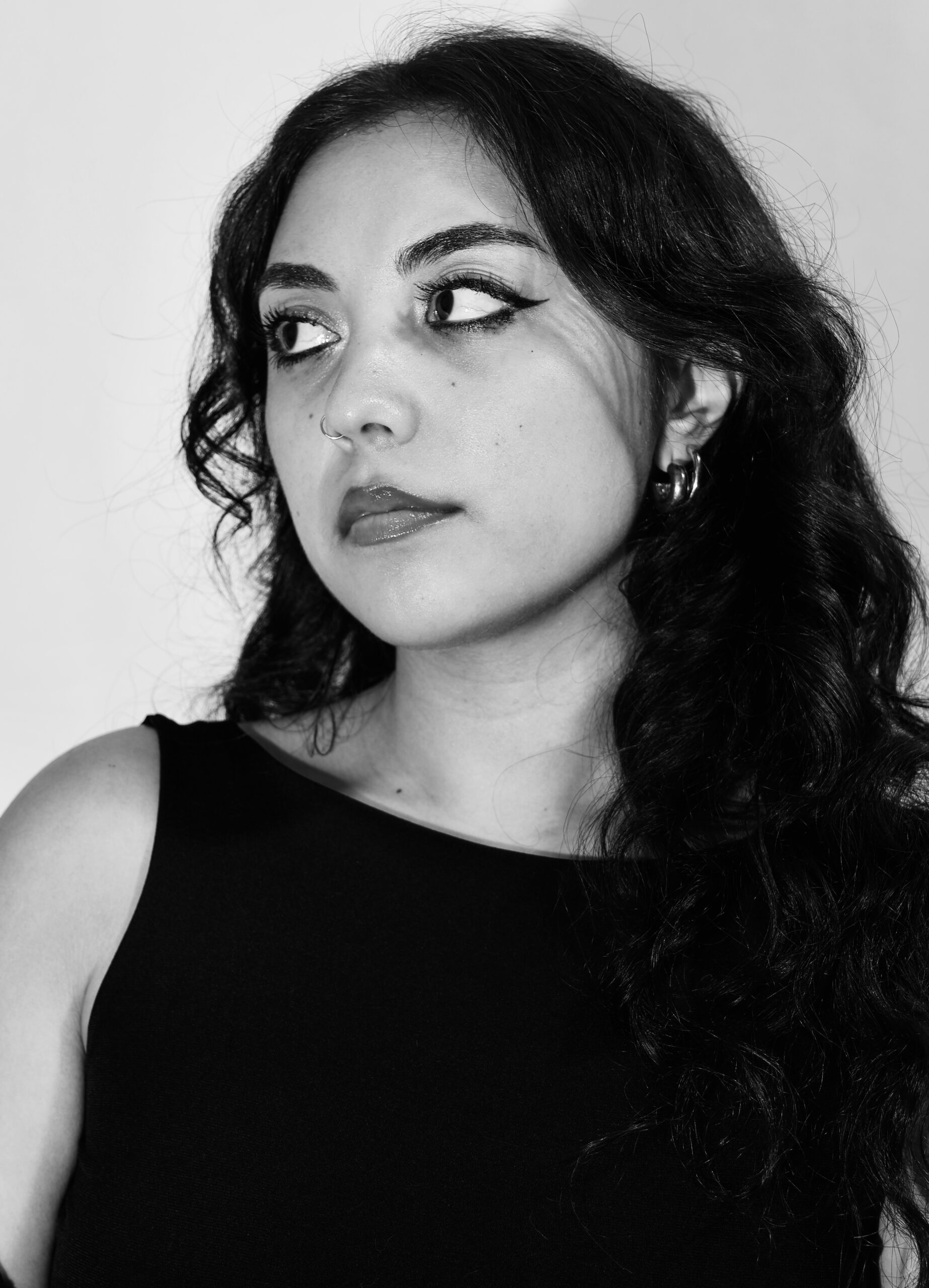
Didem Arslanoglu
Didem Arslanoglu is a Turkish-American writer based in Chicago. Her stories appear in Astrolabe, Cleaver Magazine, New World Writing, Weird Lit Magazine, and elsewhere. Find her at didemarslanoglu.com